Monday, 12 August 2013

New New Normal


Watching Cold War era films on TCM, it's hard to believe that people were once so afraid of nuclear weapons. If I was younger, I might find it almost campy, like the hyper conservative values displayed in The Andy Griffith Show and I Love Lucy.
     But it was something real, just as AIDS and Terrorism and cyber warfare were/are. The Bomb was an option, and, at any moment, whether it be the choice of our president or the British Prime Minister or the Kaiser, the world--literally the world--could be wiped away.
     So what happened?
     Stalemate. The weapon stopped being an option, at least for the 1990s. Instead, nuclear war became a concept--an abstract principle for computer geeks to build different algorithms on, or for marginalized progressive groups to get small sections of the population--the sections that still cared, which were growing smaller by the day--to get in motion and try to affect change.
     But the nineties wore on, and different, more real threats, came to the foreground: terrorists. They are our nuclear weapon. Or they were for the first half of the 00s.
     It's almost scary how used to the idea of terror we have become, much as we are so used to the constant threat of nuclear war, inequality, debt, and Putin sucking over all.
     How did we get so comfortable? Or are we just numb?

Monday, 5 August 2013

A Defense of Teachers and You and Me

     I remember, during my first years of college, a sudden outburst of these bumper stickers.
I never quite knew how to take them, being young and stupid, and, therefore, "knowing" that my teachers and professors had nothing to offer me by way of real world knowledge...and there was the matter of the fact bumper stickers come with no inflection.
     What an idiot I was.
     Though I get it now, the negative inflection I had of it then feels as though my mind was foreshadowing the political disease of Tea Party neo-conservatism. A phrase that changes the meaning by way of temporal and spatial disparities.
     How stupid could all of us have been to take that bait, even in the wake of such massive and sweeping cultural change. How could we have abandoned our educators to freely in the name of "saving this country?"
     I would never entertain the delusion that my educators were perfect celestial beings sent down to impart their secret wisdom. Sure enough, I had my share of arrogant jerk wads, a-holes, and over-steppers. I had many wonderful ones, too, who helped make me who I am: an imperfect, liberal leaning, hot-button hating, public radio listening Hipster with an Olivetti or five.
     And if more people like them were in charge, then--yes--I do believe many of this world's problems would be solved.
     How arrogant can one be to think that fixing things is something that can't be done by common folk like you and me: people pulling down 40K, working through the night, trying to help out children. What does a politician have that we don't--money?
     And we buy for that?
     England has its monarchy; we have our Plutocracy. We believed in Bush because he had the cash to make us believe. Obama didn't have the same cash, but free labor counts for something, too.
     If there was one credo we could all get behind, it is this: a problem solver--a real fixer can come from anywhere.
     Remember that Occupy and Fast Food walk-outs were not devised by a Washington genius. It was Joe and Jane Somebody. The common person is an extraordinary thing.
     That's all from Elliott at the Kitchen Table with a Boston Lager.

Monday, 29 July 2013

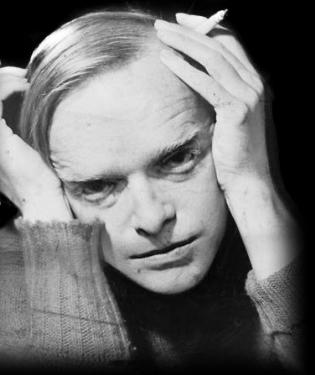
Thinking about Capote


  I had heard it once said that the difference between PTSD and a normal life is the narrative: how you recount the darkest part of the human experience--killing each other. Was it horrifying and haunting? Or do you see it as formative?
     The friendships?
     Or the phantoms?
     A writer is no warrior, but we share that commonality. We control the narrative. We need to, or else it destroys us.
     Lately a memoir has been in my brain. It is the rare and joyous kind where so much of my dark hours are spent in the footnotes. And I'm okay with that. How could I deal with those moments?
     So much of fiction is our life reflected and watered down, and writers--too often--are the least equipped to deal with them.
     Our demon devours us. They gnaw at our bones, while feeding our pen.
     In the end, they kill.
     Sylvia Plath committed suicide.
     Capote and Hemingway died from alcoholism.
     So did Kerouac.
     Then think of Tolkien, Irving, C.S. Lewis--men who, all of them, live/lived happy lives, seemingly unaffected, though their stories are fraught with darkness.
     John Irving never knew his father, and was sexually initiated at a young age. Tolkien and Lewis grew up in the shadows of two world wars, and Lewis had other, smaller

(though massive to him) issues.
     But Tolkien said, "If The Old of the Rings was an allegory for World War II, Mordor would have been occupied, not destroyed."
     Lewis wrote some of the greatest children's literature of all time.
     Irving wrote Until I Find You and The World According to Garp, not only meeting his demons head on, but conquering them in fiction.
     Be wary of what bones you want to dig up. Not all of us can be Tolkien or Irving. Unfortunately, most of us are probably more like Capote, only without the awesome skills.

Sunday, 21 July 2013

Another Kind of Manifesto

     Confession: I use a laptop, and I use it a lot. A Dell Latitude D410, it doesn't have a widescreen, and the OS is still Windows XP. I bought it last year from a tech resale shop called PC Guru, not too far from where I live. It's one of the earliest "netbooks" though it isn't actually one.
     I know that I'm a Luddite at heart, but this is the 21st century; nobody has got time for a small time scribbler and his idiosyncrasies. A deadline in 2013 does not adjust for inflation. No one wants to set typeface for a hard copy, especially in the age of online content, digital magazines, and phones like this.
     So I still submit using digital means.
     Another confession: I love my Dell laptop.
     It's compact. It boots up when I need it to. Though its shell is ridiculously bland, that utilitarian aesthetic makes me feel safe knowing that this single core processor is here to work.
     Most important, I think, is its keyboard: a subtly tactile interface. Reading up on, and testing modern laptops, it is blatantly apparent that Apple, HP, Toshiba, Sony, and all the rest are willing to sacrifice keyboard comfort in the name of thin and light.
     When did we become such wimps that any device weighing over four pounds isn't considered portable. Our parents used portable typewriters anywhere from ten to forty pounds. I've used them both, carrying them all over in the name of art.
     My Dell isn't ten pounds or even close. It rings in around four, without an optic drive built in, which allows for this little machine to have a keyboard that doesn't suck. Sure, it has its draw backs, but--I cannot stress this enough--the keys press down when you press down on them! A notebook or ultrabook today yields a paper thin keyboard, practically non-responsive--whether audibly or physically--to human touch.
     They have attempted to compensate. Sony and Apple have the best multi-touch pads. Acer and Toshiba--and most others now--have multi-touch screens.
     But none of that makes up for the keyboards. Not to me. Not all the cores, and processing power in the world can make up skimping the most regularly engage part of the computer.
     So I guess the long short of this is another kind of manifesto: Give writers a writer's laptop; that takes advantage of shrinking technology to make room for a writer's keyboard; one reinforced and rigid so it doesn't bend; with keys that are felt under the fingers; that respond to our touch and to our ears; that don't leave us fumbling for the backspace, instead hitting the backslash, or trying to shift and instead returning eleven lines before noticing.
     So I want a digital typewriter
     I want a machine made for writing first and all the rest second.
     That's all from Elliott at the Kitchen Table
 

Monday, 15 July 2013

All Grown Up About It

     John Lennon said, "Life is what happens when you're busy making plans."
     What he should have said was, "Life happens. Don't be all grown up about it."
     Sometimes we spend so much time growing up that we forget how to have whimsy, and--if only for brief moments--be like children again. It has been years since my last concert. I work nights and tickets are expensive. But there came one night I received a phone call from my best friend.
     "What are you doing Saturday?"
     "Nothing, I guess."
     "Good. You're coming with me to see Jimmy."
     That's Jimmy Eat World.
     "Okay," I told him, though I felt reticent.
     We need to go back to around 200r or so, when Jimmy Eat World came out with their follow up to Futures, which--to this day--is my favorite album of all time. And their album, Chase This Light, was a massive let down. It was too uppity, I said then, and never gave it a second listen. Sure I kept going back to Futures and Bleed American, but that feeling that I had outgrown my favorite band never left me.
     Then came the show. We stood on the floor of the theatre--Emo kids, barely old enough to drive on the left; a balding thirty year old in front of me; my clone standing almost behind me. How funny it seemed to be standing there with a whiskey sour waiting for a band I abandoned before I could drink in Canada.
     Then I was caught up in The Whirlwind, singing the "whoa's" with the rest of them. The teens and their dads.
     I gave Chase This Light another listen. It still isn't Futures, but I can appreciate it for what it is--fun; catchy. I can like "fun; catchy" every now and again. I just need to remind myself to quit being so grown up about it.
    

Sunday, 7 July 2013

Kids Say II

     Along the same lines--that of mistaking the nuances of my Mother Tongue--I son mistook another turn of phrase for something serious.
     It was the summer time, and--in my corner of the medical field--summer means a decline in the company population, in contrast to legitimate medical professions, where demand never stops. As such, I found myself on a Friday with a house only half full by eight o'clock. The clients had all gone home for the weekend, save for two. 
     In the home we have an unspoken etiquette: that we would rotate who got cut, so that there was no one person losing out on hours and money. And it was my turn to bite the bullet and go home early.
     In a way, it was fortuitous. My son was out with my girlfriend, having a day together, and they would be returning home at nine--almost the perfect amount of time for me to drive home and surprise him.
     My car pulled up just as he was walking into the backyard. As I walked up the drive, and my son heard my steps, he shouted, "Daddy, you're home early!"
     He hugged me tightly. "Why are you home early?"
     "I was cut early, Buddy!"
     He pulled away, looking me up and down. "You got a booboo?"
     Try explaining work schedules and the need to leave early due to population decline. It's much harder than explaining an analogy for the physical movement of "punching out."
     But I did my best, and--for what it was worth--thought that my son had a solid grasp of what I had really meant. But my son is a smart lad with a long memory, and he held on to his confusion for days. It wasn't until I had wholly forgotten about out discussion when, as my son was showing me some of his more recent bruises and bumps, asked, "Is your booboo better, Daddy?"
     "I don't have any, Buddy."
     "The one that you got from work, Daddy."
     I shook my head laughing, and so the vicious cycle began anew.
     That's all from Elliott at the Kid's Table, eating Lemonheads and crackers.


Sunday, 30 June 2013

Elliott at: the Kids Say Edition


Being an English major, and as such qualified for little other than reading, writing, and working at Arby's, I had always entertained the delusion that somehow my education would--by osmosis--sink into my son, making him easier to educate. After all, beautiful people make beautiful kids; English majors should make literary buffs--I read enough Beowulf for it when he was an infant.
     They don't, by the way.
     I was fast finding out that my kid was just like anyone else--full varying potential and willingness. My son, though blessed with immense physical and mental potential--becoming abnormally strong for a boy his age, at any age, and learning to speak effectively before he should have, or said his doctor--he bears the hallmark little boy bullishness for resisting to learn his language as written. He refuses to read along with his "read along" books or to write in any number of those practice books licensed by Disney.
     It's frustrating in many ways, yet in his ignorance of being four he has given us some of our funniest moments through his misunderstanding of many of English nuances.
     Our first (and best) came from his daycare. My girlfriend and I were getting ready to take him out to lunch. We did it on the same day every week, so my son, of course, knew the schedule just as well and had for more enthusiasm for it.
     When he saw us enter the daycare, he started shouting, "Daddy's here! My daddy's here!" As he grabbed my leg, he asked, "Can we go to McDonald's?"
     "Yes, Buddy, but let me punch you out first."
     He immediately retracted, his brow falling and lip jutting out. "Please don't punch me out."
     "But I have to."
     He cried. "Don't give me booboo's. I've been a good boy."
     I should add as a disclaimer that my son and I have nothing but a loving relationship. He has never been abused, and knows nothing that is not the sweet joy that should be a four year old's life.
     But I did find this misunderstanding hilarious, and I could not help it but to laugh. That did not help things.
     "I'm not going to hurt you," I reassured him, hugging him as tightly as I could.
     It took till McDonald's for me to allay his fears, though I do doubt how much of that was me explaining that, "People say 'punch out' when they are having their time card," I held up the time card, "marked for their leaving," and how much of it had to do with the fact that we were in McDonald's with a Happy Meal sitting in front of my little boy.
     That's all from Elliott at the Kids' Table at the Graduation Party.