It was announced that there is going to be another movie next year starring ole Papa--Ernest Hemingway. Not another magical bout into the past a la Midnight in Paris or an adaptation of one of his books, which has always been very close to memoir rather than outright fiction, Papa is a tale of a time in Hemingway's life when he had befriended a young journalist in Cuba. The entire movie is being shot in Cuba, which is a fact that seems to have eclipsed the very basics of the movie itself.
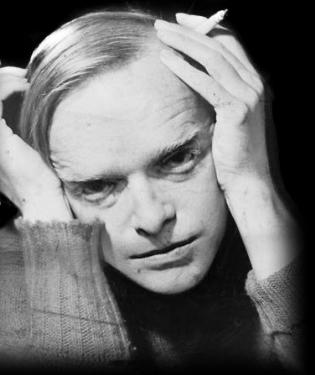
I remain ambivalent about movies about writers. Capote was an excellent look at the man during some of the most interesting years of his career as a novelist and reporter. On the other hand, The Rum Diary was a messy (at times indulgent) farce, hiding Hunter S. Thompson and his beliefs behind a supposed work of "fiction" and said little or nothing by the time the credits rolled.
My problem is that sometimes the writers tend to not be nearly as interesting as their personas lead us to believe. In the case of Truman Capote, he was an icon, whose social candor was second to none, and whose life was as interesting as he wrote it to be. In Thompson's case--and I am a big fan of his work--he was by-in-large an overly exposed drug addict, and his work suffered for it. His landmark book, Fear and Loathing: on the Campaign Trail '72, chronicled his drug addiction as much as it followed Nixon and Humphrey. And as great as it was to read the insights he had on the candidates of '72, it was equally sad to see his work fall apart because of his numerous addictions. His life, unlike Capote's, can be largely summed up as a man who wrote well for a while but was very inconsistent.

Whether Papa Hemingway is interesting enough to warrant a movie dedicated, not to his life, but to a specific moment closer to the end than the beginning remains to be seen. I suppose that 2015 is just around the corner now anyway.
That's all from Elliott at the Kitchen Table, getting ready to "pen" the next great American novel--then maybe a bar fight.
There was a recently released documentary on J.D. Salinger, chronicling his life and career in a tangential way. It's probably the most direct way of dealing with the author who pretty much invented the word "aloof."
Indirectly.
It's hard to imagine being Salinger. Reading his work, seeing the reactions that people had to him, I cannot grasp being viewed as a deity--having my words be read with the same kind of exuberance that is usually reserved for extreme right wing readers of the St. James Bible. It's obvious that there was something in water all our mid-20th century writers were drinking. Between Hemingway, Salinger, Capote, Williams, Vonnegut and the rest, I don't think that you'll find a better group of writers. There are no better prose; no cleaner syntax.
Yet these were also men obsessed with creating their own image. Capote was a drama queen to the enth degree. Hemingway went on adventures, and intentionally put himself out there so as to maintain his bad-ass manly man image. And then there was Salinger, who was as an obsessive control freak over his words. He was renown for hating anyone who tampered with his stories. He threw fits and ended friendships.
And he was obsessed with remaining out of the spotlight. That, it seems to me, only exacerbated the public's desire to know what he was up to.
As a writer and father, I tend to believe the John Irving and Stephen King model of writing: that writing is a support system for life, not life a support system for writing; that writing should never come before family. John Irving has said in interviews that he never closes the office door, because he never wants his kids to think that they cannot come in.
Do they write as well as Salinger did? Well, the answer is a solid no. They have their great works, and have written some gooder-than-hell books, but Salinger is on a freak level. And to get there he destroyed everything that is supposed to make life beautiful: family, friendship, love.
I love to write. I love to read. And I hope that one day something of mine changes a life for the better. I hope to be a writer that attracts a fan base. But never at the price of having a life.
That's all from Elliott at the Kitchen Table, waiting with bated breath for a '49 Quiet Deluxe to come back from the shop.
 I had heard it once said that the difference between PTSD and a normal life is the narrative: how you recount the darkest part of the human experience--killing each other. Was it horrifying and haunting? Or do you see it as formative?
The friendships?
Or the phantoms?
A writer is no warrior, but we share that commonality. We control the narrative. We need to, or else it destroys us.
Lately a memoir has been in my brain. It is the rare and joyous kind where so much of my dark hours are spent in the footnotes. And I'm okay with that. How could I deal with those moments?
So much of fiction is our life reflected and watered down, and writers--too often--are the least equipped to deal with them.
Our demon devours us. They gnaw at our bones, while feeding our pen.
In the end, they kill.
I had heard it once said that the difference between PTSD and a normal life is the narrative: how you recount the darkest part of the human experience--killing each other. Was it horrifying and haunting? Or do you see it as formative?
The friendships?
Or the phantoms?
A writer is no warrior, but we share that commonality. We control the narrative. We need to, or else it destroys us.
Lately a memoir has been in my brain. It is the rare and joyous kind where so much of my dark hours are spent in the footnotes. And I'm okay with that. How could I deal with those moments?
So much of fiction is our life reflected and watered down, and writers--too often--are the least equipped to deal with them.
Our demon devours us. They gnaw at our bones, while feeding our pen.
In the end, they kill.
 Sylvia Plath committed suicide.
Capote and Hemingway died from alcoholism.
So did Kerouac.
Sylvia Plath committed suicide.
Capote and Hemingway died from alcoholism.
So did Kerouac.
 Then think of Tolkien, Irving, C.S. Lewis--men who, all of them, live/lived happy lives, seemingly unaffected, though their stories are fraught with darkness.
John Irving never knew his father, and was sexually initiated at a young age. Tolkien and Lewis grew up in the shadows of two world wars, and Lewis had other, smaller
(though massive to him) issues.
But Tolkien said, "If The Old of the Rings was an allegory for World War II, Mordor would have been occupied, not destroyed."
Then think of Tolkien, Irving, C.S. Lewis--men who, all of them, live/lived happy lives, seemingly unaffected, though their stories are fraught with darkness.
John Irving never knew his father, and was sexually initiated at a young age. Tolkien and Lewis grew up in the shadows of two world wars, and Lewis had other, smaller
(though massive to him) issues.
But Tolkien said, "If The Old of the Rings was an allegory for World War II, Mordor would have been occupied, not destroyed."
 Lewis wrote some of the greatest children's literature of all time.
Irving wrote Until I Find You and The World According to Garp, not only meeting his demons head on, but conquering them in fiction.
Be wary of what bones you want to dig up. Not all of us can be Tolkien or Irving. Unfortunately, most of us are probably more like Capote, only without the awesome skills.
Lewis wrote some of the greatest children's literature of all time.
Irving wrote Until I Find You and The World According to Garp, not only meeting his demons head on, but conquering them in fiction.
Be wary of what bones you want to dig up. Not all of us can be Tolkien or Irving. Unfortunately, most of us are probably more like Capote, only without the awesome skills.